
Niraṇam is a village in the Thiruvalla taluk in Pattanamtiṭṭa district. The village is rich in antiquity; archaeological as well as socio-cultural. The place has yielded gold coins of Roman emperor Augustus, dating to the early years of Christian Era. "Niranam is mentioned in the writings of Pliny and Cosmas Indicopleustes as a trade centre where pepper grows and is known to have a variety of different settlers from Greeks to Aryan Jains. Geologists suggest that the sea retracted from this area due to some major geographical changes." Wikipedia.
The St. Mary's Orthodox Syrian Church, Kadapra along with "Niranam Jerusalem Mar Thoma Church was one of the seven churches founded by Thomas the Apostle, one of the twelve Apostles of Jesus Christ, in AD 52." Wikipedia
Three poets who made seminal contributions to Malayālam literature, known collectively as Kannaśa Kavikaḷ hailed from Niraṇam village. Their place in Malayāḷam literature can be understood from this brief quote from the book A Short History of Malayaḷam Literature by Dr. K. Ayyappa Paniker, Information and Public Relations Department, Kerala State, April 2006.
"While the Manipravala poetry flourished as a diversion from the mainstream, the tradition set up by Cheeraman of Ramacharitam and the more enlightened among the anonymous folk poets was resumed and replenished by three writers commonly referred to as Niranam poets. The Bhakti school was thus revived, and in the place of the excessive sensuality and eroticism of the Manipravala poets, the seriousness of the poetic vocation was reasserted by them. It is believed that they all belonged to the same Kannassa family and that Madhava Panikkar and Sankara Panikkar were the uncles of Rama Panikkar, the youngest of the three. They lived between 1350 and 1450 A.D. and made valuable contribution to the Pattu school. Madhava Panikkar wrote a condensed Malayalam translation of Bhagavad Gita, perhaps the first translation of the classic into any modern Indian language. Sankara Panikkars's main work is Bharatamala, a masterly condensation of Mahabharatam, is also the first major work of its kind in Malayalam. The greatest of the three is of course Rama Panikkar, the author of Ramayanam, Bharatam, Bhagavatam and Sivarathri Mahatmyam. Kannassa Ramayanam and Kannassa Bharatam are the most important of these Niranam works."
Niraṇam has two ancient temples; the Munnūṯṯumangalam Vishṇu (Narasimha) temple see in Google maps and Thrkapālīśvaram Śiva temple see in Google maps located about one kilometre apart.
Munnūṯṯumangalam Mahavishṇu || മുന്നൂറ്റുമംഗലം മഹാവിഷ്ണു ALBUM
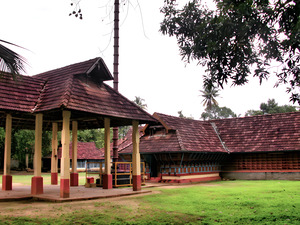 The Munnūṯṯumangalam temple is considered a grāma kshetra. This temple can be approached from Kaṭapra junction in Tiruvalla-Mānnār-Māvelikkara route and is at a distance of 9 km westwards. The temple faces west and has all the usual adjuncts of a Kērala temple viz. śrīkōvil & namaskāra maṇḍapaṃ, nālampalaṃ, valiyampalaṃ, agra maṇḍapaṃ housing the valia balikkal, āna pantal, thiṭappalli, ūṭṭupura, dhwajam etc. The southern door of the śrīkōvil adjoining the thiṭappalli also has a sōpāna with lateral entry. The śrīkōvil walls have murals and the ceiling of the agra maṇḍapaṃ displays some fine wood work.
The temple was photographed in 2003 and the same has undergone renovation since then.
Thrkapālīśvaram || തൃക്കപാലീശ്വരം ALBUM
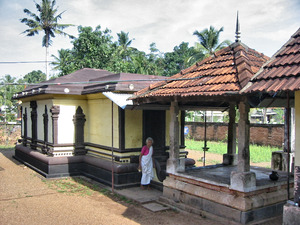 The Thrkapālīśvaram temple, about 1 km away from the Munnūṯṯumangalam temple is at a distance of half a kilometre from Ālumthuruthi Bridge stop in Tiruvalla-Mānnār-Māvelikkara route.
This small temple was photographed in 2003 and 2007. Today (May 2024), the śrīkōvil photographs you would see in this portal serves only an archival purpose. The structure has been replaced with a modern one which can be seen here. The śrīkōvil structure was in the Dravida pattern with a pyramid shaped flat roof of stone and had a mukhamaṇḍapaṃ attached to it, and a small and simple four pillared namaskāra maṇḍapaṃ in front.
Idols of sapta-māthrkkaḻ are enclosed in a small structure south of the śrīkōvil. The sapta mathrukkaḻ idols are of Chāmuṇḍa, Indrāṇi, Vārahi, Vaishṇavi, Brāhmi, Maheśwari & Kaumāri along with Gaṇapaty at one end facing East and Vīrabhadran at the other end facing West. These sapta-māthrkkaḻ images are considered one of the most beautiful and wholesome figures found in Kerala. According to H. Sircar (Architectural Survey of Temples of Kerala, Archaeological Survey of India, 1978, pp 106), ". . . the Sapta-mātṛikā images were available in the eighth and the ninth centuries throughout the west coast. The cult possibly spread to this region from the Chālukyan country because the early Chālukyan kings are described in their inscriptions of the sixth and seventh centuries as the off-spring of Hāriti and nurtured by the Seven Mothers (Hāritīputrāṇām sapta-lōka-mātṛibhiḥ Sapta-Mātribhiḥ)."


